
Safety Tips
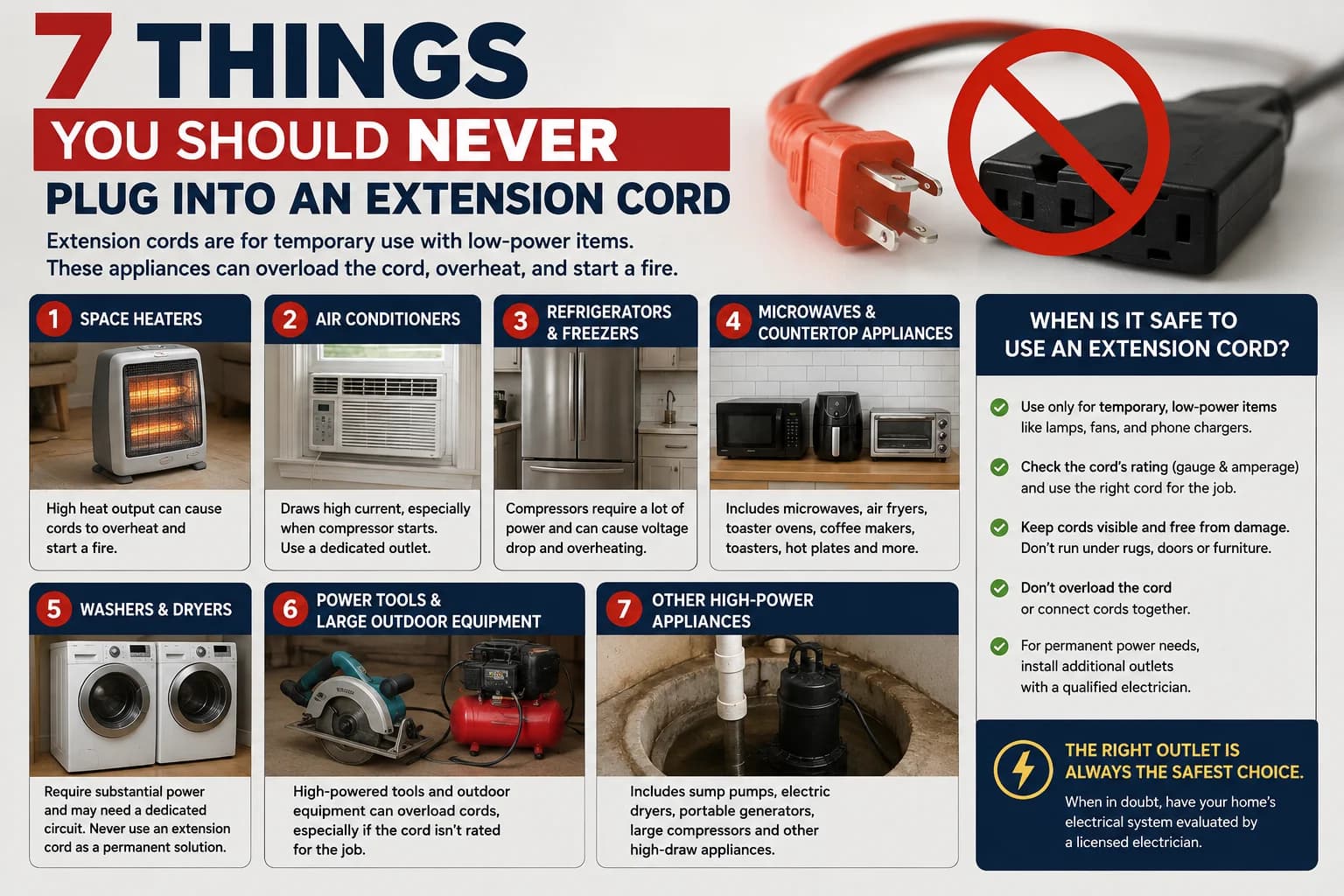
7 Things You Should Never Plug Into an Extension Cord
By David Bidwell
7 Things You Should Never Plug Into an Extension Cord
Extension cords are convenient when you need to bring power to a device that’s out of reach of a wall outlet. But convenience can become a safety hazard when an extension cord is used with the wrong appliance or overloaded.
Knowing what should never be plugged into an extension cord can help prevent overheating, electrical fires, damaged equipment, and serious injuries.
What Is an Extension Cord — and Why Can It Be Dangerous?
An extension cord is designed to temporarily extend the reach of an existing electrical outlet. It is not intended to replace permanent wiring or provide power to high-demand appliances on a long-term basis.
Every extension cord has a maximum electrical capacity. When an appliance draws more current than the cord can safely handle, the cord can overheat.
Here are seven types of equipment that should generally be plugged directly into a properly rated wall outlet or dedicated circuit rather than an ordinary extension cord.
1. Space Heaters
Space heaters can draw a substantial amount of electricity. An extension cord that isn't rated appropriately can overheat and create a fire hazard.
A space heater should generally be plugged directly into a wall outlet, following the manufacturer's instructions.
Never run a space heater's cord underneath rugs, furniture, or other materials that could trap heat.
2. Air Conditioners
Portable and window air conditioners can draw significant amounts of electricity, particularly when the compressor starts.
Do not use an ordinary extension cord with an air conditioner unless the manufacturer's instructions specifically permit it and the cord is properly rated for the appliance.
An undersized or excessively long extension cord can overheat, experience voltage drop, or create a fire hazard.
If your air conditioner cannot reach an appropriate outlet, the safer solution may be to have a properly located receptacle installed.
3. Refrigerators and Freezers
Refrigerators and freezers have compressors that can require significant power, particularly when starting.
Using an extension cord can create voltage-drop and overheating concerns, especially if the cord is too long or has an inadequate wire gauge.
For major appliances such as refrigerators and freezers, follow the manufacturer's electrical requirements and use an appropriately installed outlet.
4. Microwaves and Countertop Appliances
Many countertop appliances can draw a surprising amount of electricity.
Examples include:
Microwaves
Toaster ovens
Air fryers
Electric griddles
Coffee makers
Toasters
Hot plates
Electric kettles
These appliances can draw substantial current, and plugging several of them into the same extension cord or power strip can overload the cord or circuit.
High-wattage countertop appliances are best plugged directly into an appropriate wall outlet.
Avoid using an extension cord simply because the appliance's factory cord doesn't reach the outlet.
5. Washers and Dryers
Laundry appliances require substantial electrical power and, depending on the appliance, may require a dedicated circuit.
Never use an ordinary household extension cord as a permanent power source for a washer or dryer.
If the appliance cannot reach its required outlet, the better solution is to have the electrical system evaluated and the outlet installed or relocated properly.
6. Power Tools and Large Outdoor Equipment
Power saws, compressors, pressure washers, lawn equipment, and other high-powered tools can place a significant load on an extension cord.
That doesn't mean every power tool can never use an extension cord. The important question is whether the cord is specifically rated for the tool, its amperage, its length, and the environment in which it will be used.
Outdoor equipment should use cords rated for outdoor use and should be protected by a properly functioning GFCI where required.
7. Other High-Power Appliances
The general rule isn't limited to the appliances listed above.
Be cautious with any appliance that produces heat, contains a large motor or compressor, or has a high wattage rating.
Examples include:
Electric dryers
Freezers
Sump pumps
Portable generators and generator-connected equipment
Large compressors
Electric cooking equipment
High-powered shop equipment
Always check the manufacturer's instructions and the electrical rating of both the appliance and the cord.
When Is It Safe to Use an Extension Cord?
Extension cords can be perfectly useful when they're used correctly.
They're generally best suited for temporary, lower-power applications, such as plugging in a lamp, small fan, phone charger, or similar device.
Before using one, check the following:
Choose the correct gauge. Higher-powered devices generally require heavier-gauge wiring.
Check the cord's amperage rating. It must be capable of handling the connected load.
Use the correct type of cord. Outdoor applications require cords rated for outdoor use.
Keep the cord visible. Don't run it under rugs, carpets, doors, or furniture where heat can build up or the cord can be damaged.
Inspect it before use. Don't use cords with cuts, frayed insulation, exposed wires, damaged plugs, or loose connections.
Don't overload it. Avoid plugging multiple high-powered appliances into one extension cord.
Don't connect extension cords together. Using one extension cord to extend another can increase resistance and create additional hazards.
Use power strips appropriately. A power strip doesn't increase the amount of electricity a circuit can safely provide.
Treat extension cords as temporary. If you need power in a particular location on a permanent basis, have a properly installed electrical outlet added.
What About Countertop Appliances?
Countertop appliances deserve special attention because it's easy to assume that their relatively small size means they don't use much electricity.
That's not necessarily true.
A microwave, air fryer, toaster oven, electric kettle, or hot plate can draw a significant amount of power. Using several of these appliances simultaneously on one extension cord or power strip can overload the cord or the circuit.
Size doesn't determine electrical demand — wattage does.
Check the appliance's rating label and manufacturer's instructions before deciding how it should be powered.
The Bottom Line
Extension cords aren't inherently dangerous. Using the wrong extension cord for the wrong appliance is the problem.
Avoid using ordinary extension cords as permanent wiring or with high-demand appliances such as air conditioners, space heaters, microwaves, countertop cooking appliances, refrigerators, dryers, and large power tools unless the manufacturer specifically allows it and the cord is properly rated.
If you regularly need extension cords because an outlet isn't available where you need power, that's a good indication that your home's electrical system may need an additional properly installed receptacle.
When electricity is involved, the right solution isn't always a longer cord — sometimes it's a better outlet.
Keep Reading
More from the Blog